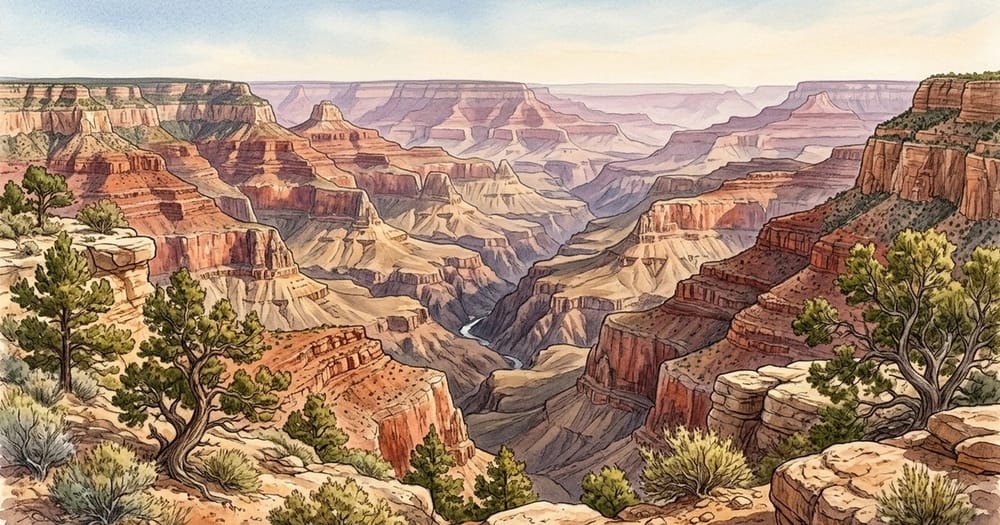
Imagine opening a very thick book and finding that someone has cut a winding passage through its pages. You can see the edges of chapter after chapter, all at once.
The Grand Canyon is not a book, of course. But its walls do reveal parts of a story that would otherwise be hidden underground. There are clues to seas, sandy landscapes, rising land and moving water. To understand the canyon, you need to ask two different questions: how did the rocks get there, and how did the great opening through them form?
Those are not the same story. Let’s turn the pages in order.
Where is the Grand Canyon?
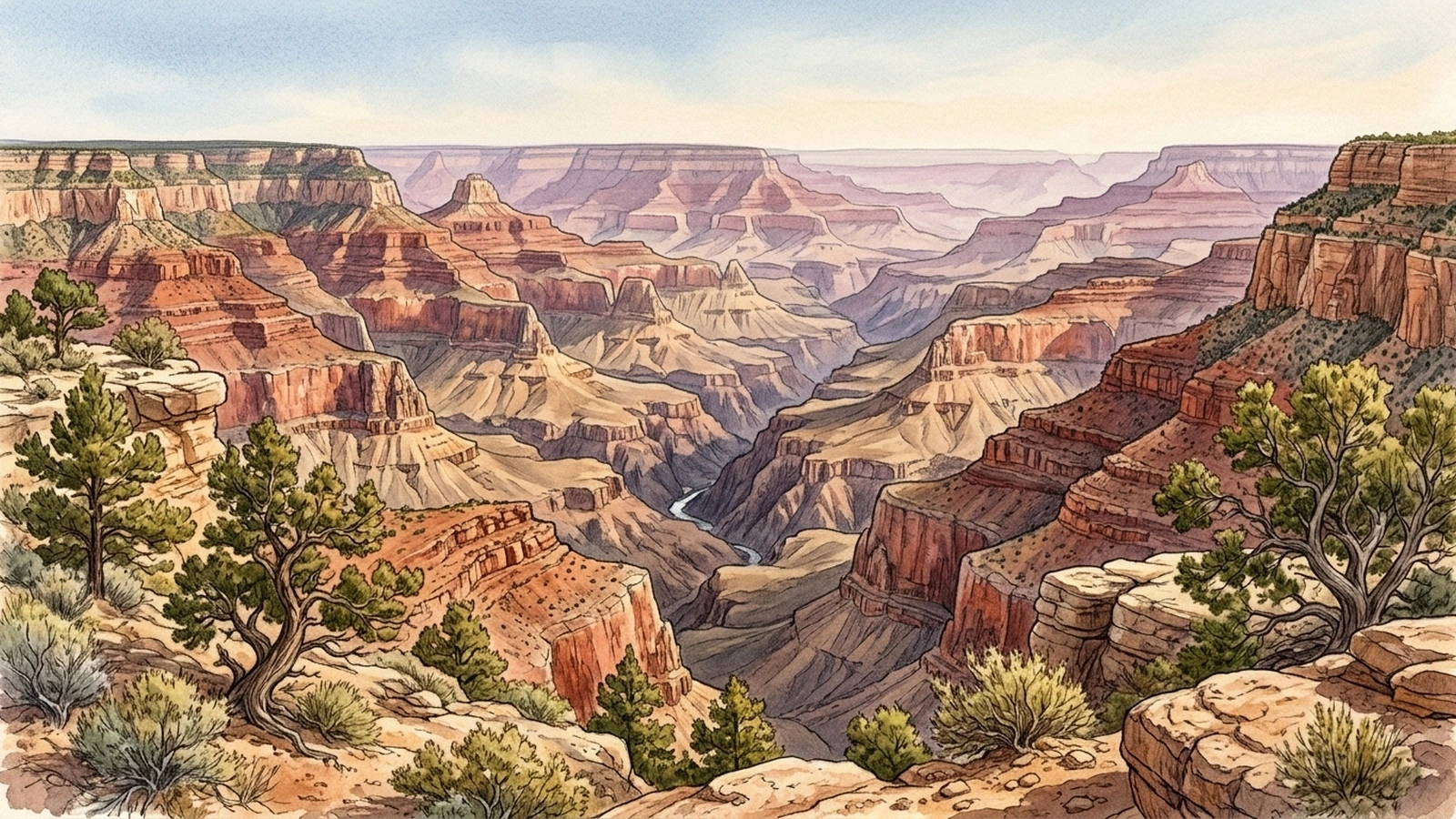
The Grand Canyon is in northern Arizona, in the United States. The Colorado River flows through it, far below the rim — the upper edge from which people often look down.
From above, your eye might follow the river first. Then you notice the walls: bands of colour, ledges, steep cliffs and gentler slopes. Those shapes are clues too. Different rocks respond differently to weathering and erosion, so the canyon does not wear away as one smooth surface.
It is tempting to imagine the river scooping out a ready-made trench in a single dramatic moment. The real explanation needs much more time, and several processes working together.
First came the materials that became rock
Long before the canyon existed, sand, mud and other material collected in this region. Geologists call loose material like this sediment. Some was deposited in water; some belonged to other environments, including sandy landscapes.
Over long periods, buried sediment was compacted and cemented into sedimentary rock. New deposits could settle above older ones. In an undisturbed sequence of sedimentary layers, the lower layers are generally older than the ones above them.
Think of putting one sheet of paper on your table each morning. After a week, the first sheet will be at the bottom. That helps you picture the order, although paper does not become rock merely because you stack it.
The canyon’s rocks did not all form in one continuous sea. Different layers preserve evidence of different environments at different times. Nor is every rock exposed in the canyon sedimentary: some of the oldest rocks have a different, deeper geological history.
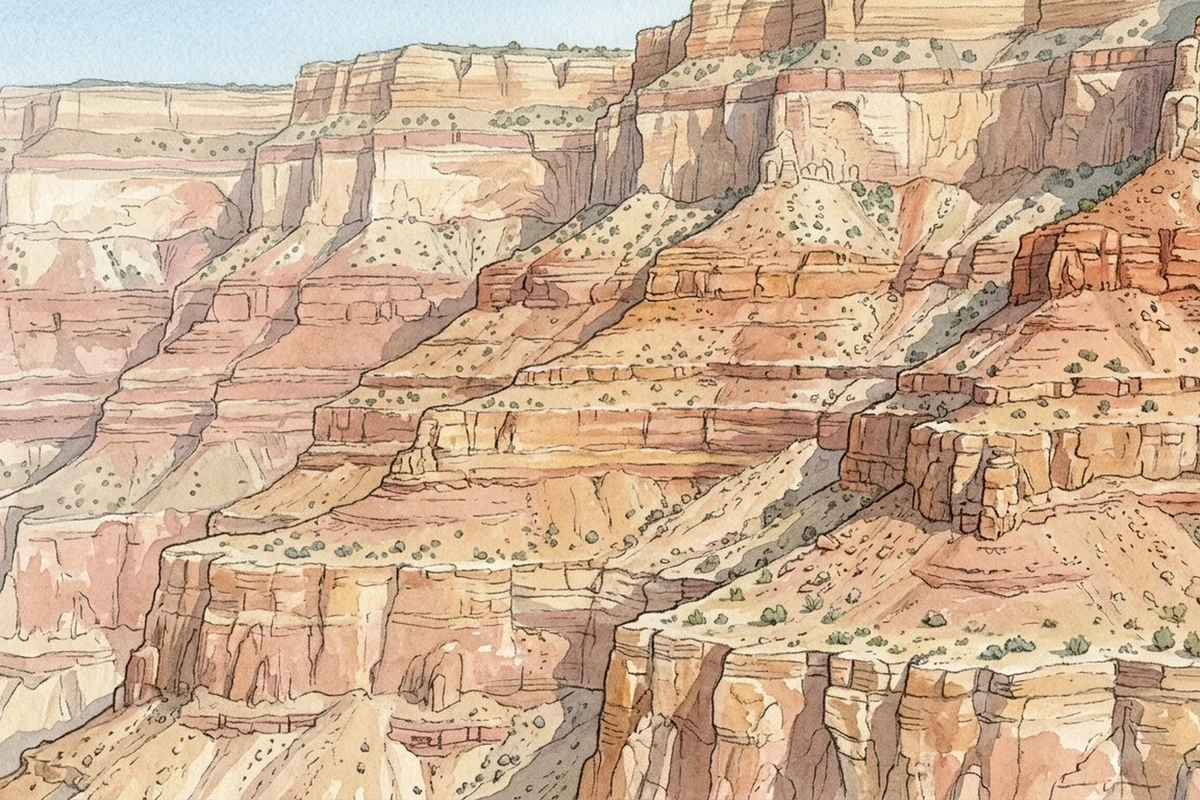
How can an ancient sea floor be high above the sea?
Near the top of the canyon lies the Kaibab Formation, which includes limestone formed in an ancient marine environment. It is about 270 million years old.
Yet it is now high above sea level. How can that be?
The land moved. Over geological time, the Colorado Plateau — the broad region containing the Grand Canyon — was uplifted. Rocks that had formed much lower down ended up at a greater height.
This did not mean a finished canyon was hoisted into the air. Uplift helped create the conditions in which rivers could cut down into the landscape. Deposition, uplift and erosion belong to a long, complicated history, not a set of perfectly separate steps with a neat pause between each one.
That is worth remembering whenever you see a simple diagram. A diagram helps us follow the main ideas. The Earth does not have to be quite so tidy.
How does a river cut into rock?
Moving water can carry sediment and wear away material. As the Colorado River flowed through the rising landscape, it cut down into the rocks, exposing older material below. Geologists call this downcutting.
The river did not do everything alone. Smaller streams joined it, cutting side canyons. Weathering broke down exposed rock, and gravity helped move loosened material downhill. Together, these processes helped make the canyon wider as well as deeper.
Here is a useful distinction: weathering breaks rock down where it is; erosion removes and transports material. In a real landscape they often work together.
The National Park Service sums up the formation story with four ideas: deposition, uplift, downcutting and erosion. The first two help explain the rock-filled landscape. The later processes help explain the opening through it.
Water is not a magic knife. It works within a landscape whose rocks, height and structure matter too. The interesting question is not just “What did the river do?” but “What did the river have to work with?”
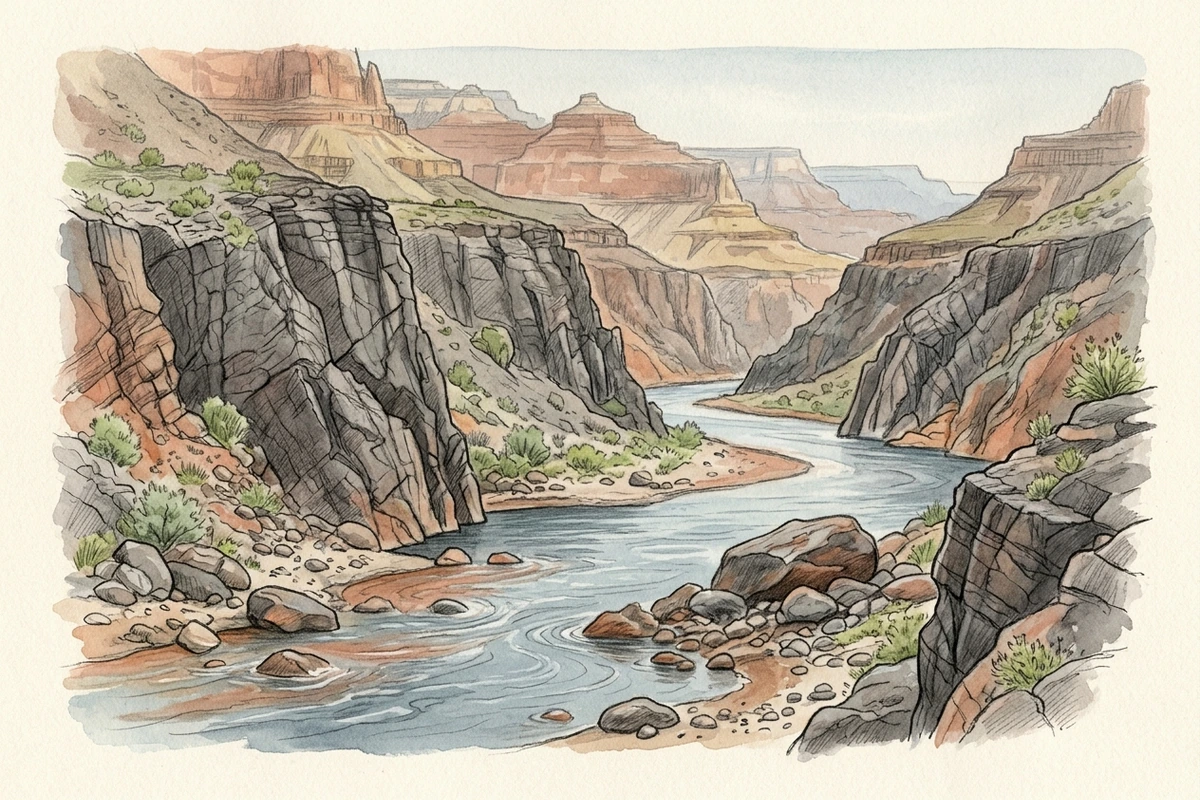
How old is the canyon — and how old are its rocks?
Suppose you cut a doorway into an old wall. The doorway is new, but the bricks are not. Their ages tell you different things.
The same distinction helps with the Grand Canyon. Some exposed rocks are about 1.8 billion years old. The Colorado River’s carving of much of the canyon is commonly described as happening over roughly the past five to six million years.
That does not mean every rock was made when the canyon formed. It also does not mean scientists have attached one perfectly agreed birthday to every part of the landscape. The canyon’s detailed history is still being investigated.
When someone gives you an age, ask a small but powerful question: an age for what? The rock? A particular layer? The river’s course? The opening through the rocks?
A careful question can be more useful than a very large number.
Wonderfully Weird Facts
- Some rocks near the top began in an ancient marine environment. Their present height tells a story about moving land as well as vanished seas.
- The opening is much younger than some of the rocks it exposes. Looking down the canyon is not the same as watching all its rocks form.
- The river is only part of the shaping team. Tributaries, weathering and gravity help explain the broad, branching landscape.
- A rock record can have gaps. Two neighbouring layers do not always represent neighbouring moments in time.
That last discovery opens a particularly good rabbit hole.
Down the Rabbit Hole: can a rock book have missing pages?
Imagine that your paper diary jumps straight from Monday to Friday. Did Tuesday, Wednesday and Thursday fail to happen?
No. Their pages are missing.
Geologists sometimes find a similar puzzle where rocks meet. There may be a gap in the record because sediment was not deposited, or because rocks that formed were later eroded away. Such a break is called an unconformity.
The Grand Canyon contains important examples, including the Great Unconformity. The missing part is the rock record, not time itself. A surface between rocks can therefore tell a story of change even when the material that would have filled the gap is gone.
This also explains why “older below, younger above” is a starting point rather than a complete history. You still need to investigate what happened between the surviving layers.
And once a canyon exists, it creates another question: what can live among all those different levels? Follow that thought into What Animals Live in the Grand Canyon?.
Try It Yourself: make a paper-layer canyon
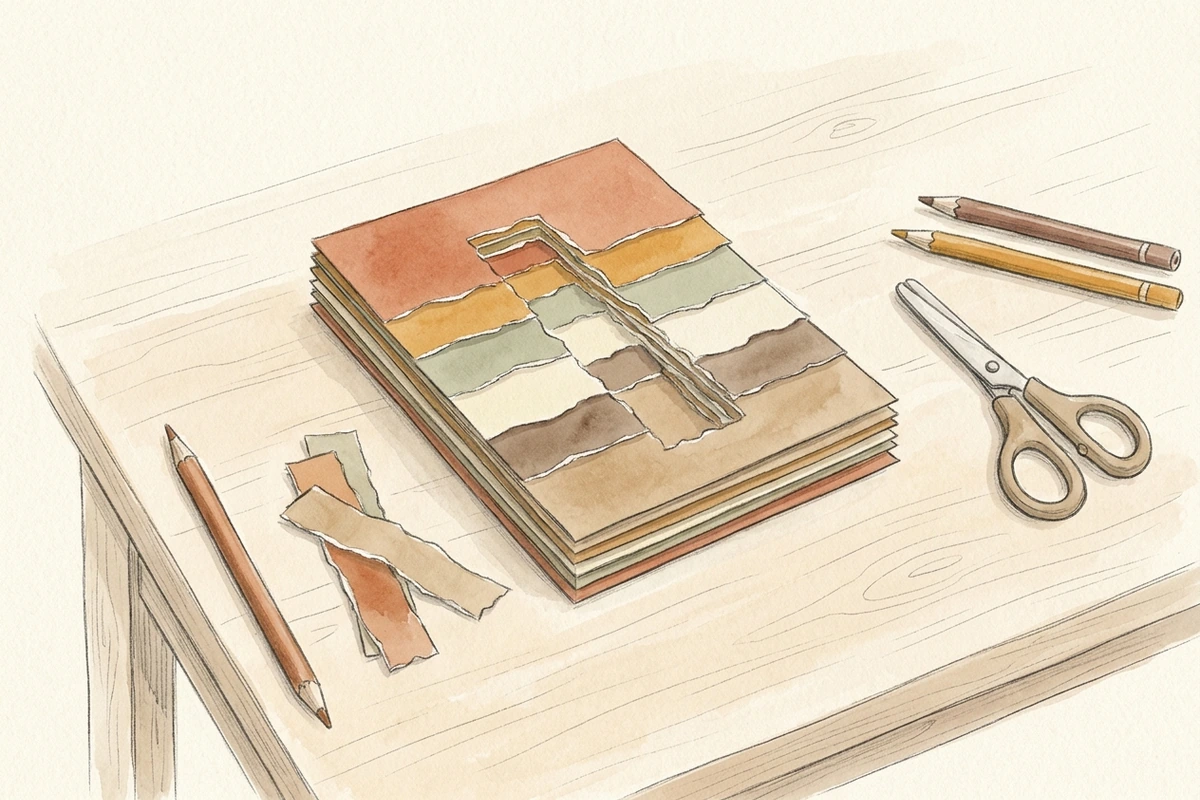
You will need several sheets of differently coloured scrap paper, a pencil, a tray and scissors. Ask a grown-up to help with cutting.
- Stack the sheets and decide that the bottom one represents the oldest layer. Number a corner of each sheet so you can remember the order.
- Draw a narrow winding route across the top sheet. With adult help, cut a narrow opening through the stack, leaving paper on either side.
- Put the removed strips on the tray rather than throwing them away. Notice that making an opening means material has gone somewhere else.
- Arrange the two sides so the coloured edges show. Can you work out the order of the layers from their exposed edges?
- Make one layer wider or narrower than another. How does that change the outline you see?
Now do the most important part: explain what your model cannot show.
Scissors are not flowing water. Paper is not rock. You have not reproduced uplift, weathering or millions of years. What you have made is a way to think about layers becoming visible when material is removed.
For an extra puzzle, take one numbered sheet out before rebuilding the stack. What evidence suggests a page is missing? Remember that this is a model of an incomplete record, not an experiment proving how any particular unconformity formed.
Grown-up note: supervise scissors and clear away small scraps. If you explore outdoors, stay on permitted paths, well back from cliff edges and water hazards. Leave rocks and fossils where site rules require them to remain.
The Big Takeaway
The Grand Canyon is not simply a very old hole. It is a younger opening through a much older rock record, shaped by uplift, moving water, weathering and gravity.
Next time you look at its banded walls, try asking both questions: what made these rocks, and what revealed them? One landscape can hold more than one story.
Sources and Further Reading
- National Park Service: Geology of the Grand Canyon — deposition, uplift, downcutting and erosion, with the distinction between rock age and canyon age.
- US Geological Survey: Geology of Grand Canyon National Park — rock layers and the environments they record.
- National Park Service: Geologic Formations — a closer look at the canyon’s different rocks.
- National Park Service: Missing Time at Grand Canyon National Park — unconformities and gaps in the geological record.
Explore another part of the story in Which Native Nations Are Connected to the Grand Canyon?. Keep exploring with our Wonder lesson, Where is the Grand Canyon?, with a children’s Journal and an accompanying Parent Guide to help you guide the lesson.